Why is my spine bent? Why is it an “S” shape and not a straight column?
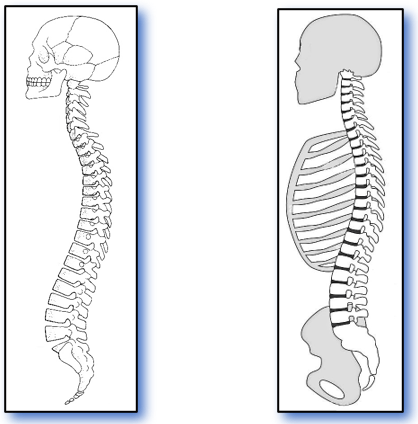
I was going to put in a load of pretty diagrams, but, frankly, my graphics package is pants. So, you will need to follow the words. Or join the D and the S and watch Netflix.
Well, there are three good reasons:
- You can see the ribcage, and that means the lungs and under that is the stomach and guts, so the spine bends round them to keep the whole thing balanced.
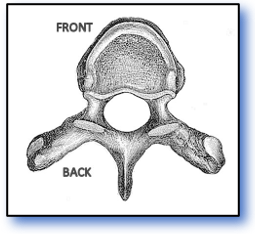
- You can see from the diagram that the spine is pretty substantial. The vertebrae have big bony protrusions at the back because they are the main protection from attack from behind, whether by enemies, predators or just the environment. This is essential because the eyes basically face forward, and nasty things can creep up behind you or you could fall over.
- The other reason is so that it is flexible.
For me this last reason is the interesting one.
If the spine were a straight vertical column: if you jumped off a wall or a rock and landed awkwardly, it would probably shatter under the impact. Or there is the possibility that the spine would be driven upward into the skull, either stunning you, or worse.
With a curved spine, you might get soft tissue damage, a sprain or strained muscles, but the skeleton would remain pretty much intact.
Even in normal walking, there is a shock load with each heel strike on the ground. With a curved spine, this can be eased by tiny flexings in each vertebral joint. Probably the flex in each joint could not be measured, but over the length of the spine, it builds into an efficient shock absorber.
There are discs between each vertebra which can absorb the shock loads and ease the rotation of the spine, improving its flexibility and suppleness. We know these can be damages of simply wear out, causing excruciating pain and all sorts of troubles.
You can also see that the curved spine allows the bottom end to be under the connection to the skull at the top. This means that the overall load is acting straight down to the main load bearing structure, the hips.
You will also notice that the lower vertebrae are much larger than those in the neck. They carry more load, increasing with each step until the last one is carrying the entire weight of the torso and the arms – and whatever they may be carrying.
Pretty neat, huh?
Now this type of engineering solution applies to a lot of the bones in the skeleton. In fact, you don’t have a rigid bone in your body. By “rigid” I mean a totally inflexible bone like a piece of concrete. Sure, when you’ve cooked ‘em, they’re brittle. You just destroyed all the flexibility in the cooking process. Or if they have been unused and unnourished for some time, i.e., dead, they will become brittle. But while they are in a healthy, living, body, they all have just enough flexibility to absorb the shocks of nearly everything and some of us go an entire lifetime without stressing any of them to the point of failure.

 Flights of the butterfly
Leave a reply to Jem Cancel reply