Mike and Pablo
Mike was a painter. You may have heard of some of his work. He did the ceiling of a chapel somewhere which everyone raves about. (It was a bit of a surprise for the old Popeydope who was expecting two coats of magnolia emulsion.)
Mike had an assistant called Pablo, of whom nobody has heard. That’s because Pablo kept doing weird pictures of women with both eyes on the same side of their head and suchlike. Mike had to fire him in the end. He just couldn’t do art, according to Mike.
Put it another way, people, society, humanity had to go through a few hundred years of development and art had to go through the same process before the work of Pablo Picasso could be appreciated.
What would happen if a genuine, signed Picasso were to be discovered in Michelangelo’s attic, dated to the 14th or 15th century? Think about it, it will hurt your head.
As Picasso himself said, when he saw the cave paintings of Lascaux: “In twenty thousand years, we have learned nothing.”
Lenny and the Chopper
Lenny was a mate of mine who did a bit of painting. He also fiddled about with other bits and pieces.
He drew a helicopter. A bit weird by our standards, but he had the idea of a machine that could fly and had a single rotor.
Now, what would happen if a brilliant Aeronautical Engineer went back in time, saw Lenny’s sketch and said, “you’re on to something, Lenny. Let’s build it”?
How long would it take, given that this is the best, THE best, aeronautical engineer?
Easy
Leonardo sketched the machine around 1481.
On September 14, 1939, the VS-300, the world’s first practical helicopter, took flight at Stratford, Connecticut
Answer? 458 years, give or take.
Before they can start building, they need to have the machine tools to fabricate the parts. Well, that won’t be until the industrial revolution, a couple of hundred years.
They need to invent the internal combustion engine ( around 1794-1813)
And build it. That needs precision tools, electric tools, industrial equipment.
And steel. Lots of steel. That means a Bessemer converter to turn iron into steel. Around 1850.
Oh, and you’ll need some mathematics, almost certainly some calculus. Isaac Newton(1643 – 1727) and Gottfried Leibnitz(1646 – 1716), over here, please gentlemen, we have helicopters to build.
Now, even if our engineer can do all this stuff himself, he still needs to have helpers. And they need to be taught, and that takes time.
And then there’s wars and disease and politics and stuff.
What all this means is that there are no real shortcuts in history.
So , how long to build a helicopter? 458 years.
Steam Engines
There is a saying, attributed to Charles Fort in 1931, “when it’s steam engine time, someone will invent the steam engine.”
This refers to the phenomenon of the invention of an idea or a technology by different unconnected people at different places around the world at the same point in history.
These inventions or ideas are waiting to happen but they need the infrastructure to allow them to happen.
And this is Infrastructure with a capital INF.
It means the infrastructure of education, of technical development, of scientific development, of cultural development, political development, communications, readily available skills and materials.
There are no shortcuts.
And it applies to art as well.
St Francis and the wolf
I need to get this loaded as soon as possible.
St Francis and the wolf, painted by Stefano di Giovanni (1392–1450).
It is in an altarpiece dated around 1437 – 1444. The first thing to note is Stevie died at the age of 58, and painted this no later than when he was 52.
He’d seen stuff.
By now, they had worked out how perspective can be portrayed. If you follow the lines on the building, they converge on a vanishing point “offscreen” (Ignore the three jet fighters in the middle of the picture. Just a future echo.)
There seems to be a problem with most of the elements in the picture that aren’t buildings.
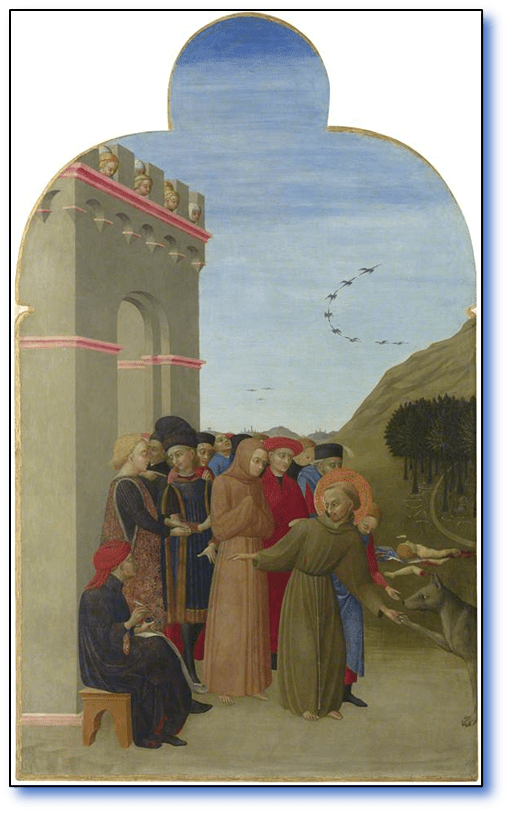
The thing about flying geese is that the buggers won’t keep still while they are flying, Makes it tricky to work out what they are actually doing. Unless, of course, you have been brought up in the age of the camera. Then you can capture exactly what is happening when a bird is in flight. If you live in the age of motion pictures, its even better. And if you live in the world of freeze-frame analysis you can see exactly everything as it happens.
Stevie and all of them had to try to remember what they had seen until they got back to the studio, set up the easel, found some canvas, mixed some ink and then tried to remember what they saw. They had chalk and stuff, but not paper and pencil. At least not as the common everyday commodity.
It was art, Jim, but not as we know it.
You will also have noted that all the figures are pretty static. Sure, it was easy to see how cloth folds fall. When you had a piece of cloth draped over a chair that you could study and keep practicing until you got it right. But what happens when someone is walking or running and the clothes are moving all over the place? Easy. Just take a pic on your phone. Oops.
This explains why a lot of the Old Masters’ work showed very stilted and artificial poses and gestures.
We’ll get back to that later, it has to do with the interactive feedback of media and society (a PowerPoint presentation is available, NOT, and if I ever find you using one. There will be blood.)
And then there is the wolf.
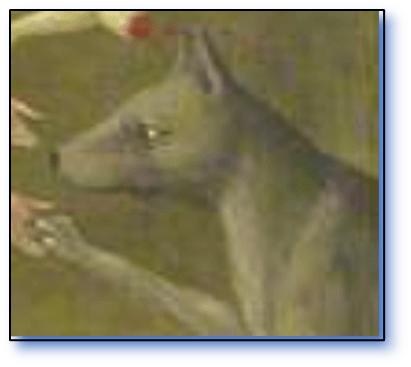
Or actually there isn’t. That ain’t no wolf.
If Stevie baby ever saw a wolf, he would be too busy running and screaming to think about what it actually looked like and anything he did draw would have a lot of brown stains in it. It would have been big, big fangs, an enormous snarl and glowing, sulphurous eyes. Not the kind of creature to engage in social chitchat with a saint. So he tried to draw a dog that wasn’t a dog and that didn’t work either.
Perspective.
Now, Li’l Stevie did pretty good with the perspective on the buildings, and if you look at the hillside, it works quite well. But, the path, the wood, the bones and the body parts. Not so good.
To our eyes.
Stevie is using what we regard as a childlike system of perspective. Elements in the picture are assigned size according to their importance to the narrative.
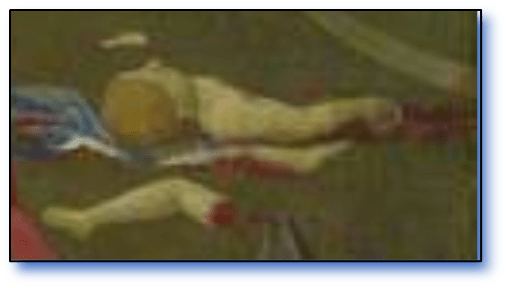
Forgive the gruesome interruption, but you will notice the dismembered corpse lying in the background. First, you see that the parts are not in proportion. The head is too large for the feet of a normal adult. The whole heap is too large, by our perspective, for its position in the mid distance. But, Stevie is telling a story. This heap of meat is very important to his story, so he has bigged it up a bit.
Why should we think Stevie is wrong just because we were brought up in a photographic world? It makes sense if the painting is a story, not just a picture.
Just a quick note on the hillside. It is pretty monochromatic. Paint was expensive and you had to make your own. So I can forgive Stevie for using up all the green.
The trees aren’t much good either. They are difficult to get the hang of. It wasn’t until much later that artists realised you didn’t have to do every leaf to make a tree, you could take shortcuts with chunks of different shades of green and brown and a bit of texture.
Artists learn from their mistakes; I expect the first one who did good trees thought he’d got it wrong until he stood back and looked at it.
My Dad painted a very good picture of a tugboat going upstream on the Thames past the Tower. He didn’t like the way it was going and had started to rub it out when my Mum yelled at him to stop. She told him it was beginning to look all foggy and smoky. A little but more work with the rag, and the failures became one of his good paintings, all misty and smoky.
That’s about it for Stevie.
The martyrdom of Saint Sebastian
Painted by Piero del Pollaiuolo (after 1475)
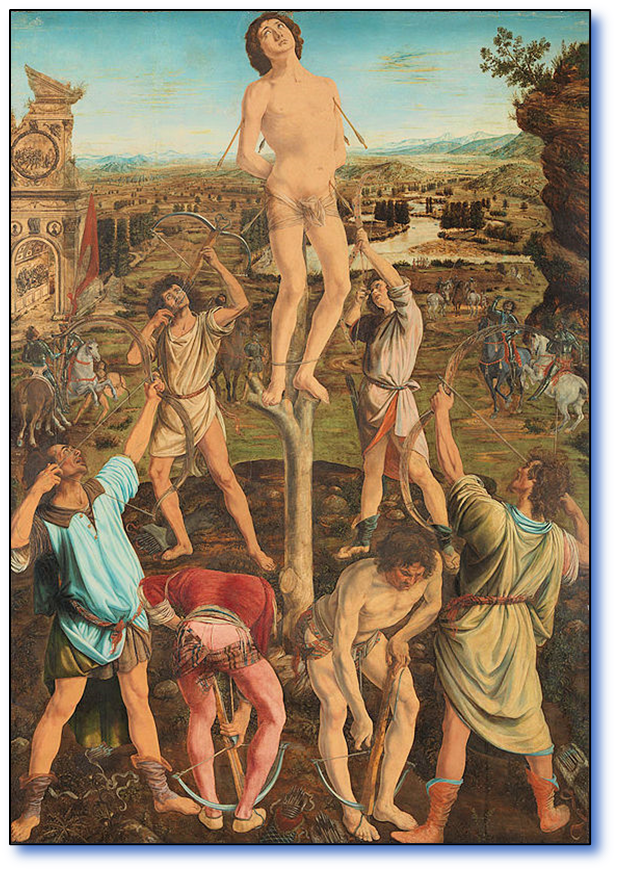
First of all, a big up to Pete for getting four consecutive vowels into his surname. Not easy.
Next, the bloke on the pole. Now if you can look like such a long-suffering smug dick while being shot full of arrows, you deserve everything you get.
Again, the perspective of the landscape works for the 21st century eye. But somehow the figures in the middle distance just don’t deem to be quite right. The catch my eye more that I would have expected, but then maybe that is to emphasise their importance to the story. Perhaps it should be called “narrative perspective”.
Anyway, that’s not why we’re here.
First, obviously, Pete never saw anyone getting shot full or arrows and although Brian May is about my age, I don’t think that’s him at the back playing riffs on a crossbow.
We’re interested in the two dudes at the front. Because this is about art as history.
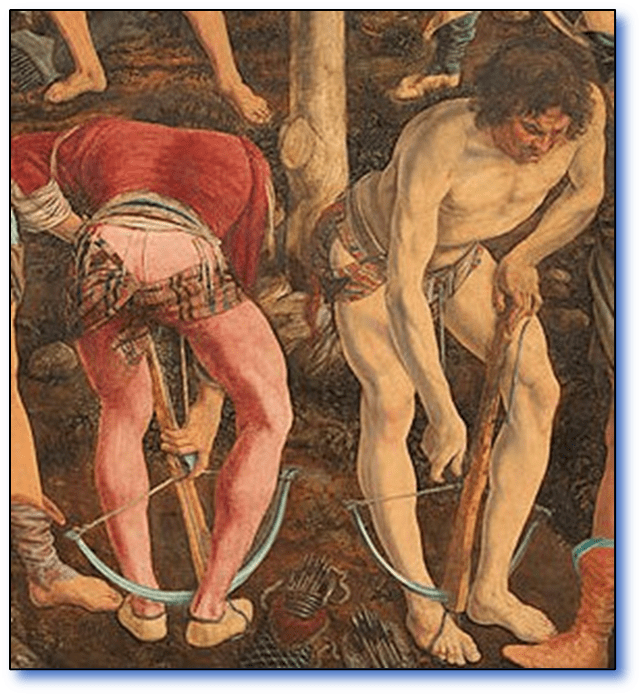
The first thing to notice is that, from the colour, they are using steel crossbows. Iron won’t work, it won’t spring in the way steel does. This means that they have access to tempered spring steel, probably very expensive, but available.
They have both bent down to reset their bows. They are attaching a hook to the bowstring with a cord leading to a loose-fitting broad belt. An important point, if you look at Bepe, on the right, is that the belt sits on his hips, and not on his waist.
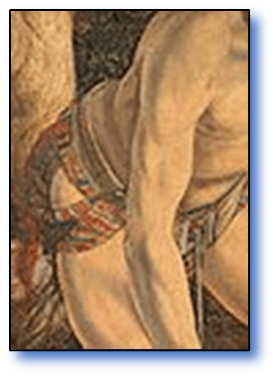
With his legs fully bent, the hook set to the bowstring, when he stands up, all the load will come on his hips, thighs and legs. Not his back. This means he can operate the weapon without risking his back. Neat, but to be expected as common knowledge before the days of car jacks and forklift trucks.
There is a stirrup on the end of the crossbow to hold it steady and you can see that both men have straddled the bow during reloading.
So what is the GOF going on about? Why is it so important and what has it to do with either history or art?
The point is: it is a lengthy, complicated process that requires the bowman to look away from the target.
The steel crossbow of that era could outrange the longbow. But, it was mechanically inefficient. This means it needed about twice the draw-weight, the pull, to match the longbow’s range.
Now, longbows have been found with draw-weights up to 150lb (68Kg). that means that to match this, a crossbow would need a draw-weight of about 135Kg – too much to pull without the hook thingy that shifts the load to the legs.
And that means a long and lengthy reload process.
Longbowmen could shoot between 6 and 10 shafts a minute. Crossbowmen would be lucky to get off two.
Moreover( hey, now there’s a word), the crossbowman had to look away to reload and then re-acquire a target, assess threats and do all the other fun things when fighting for your life. The longbowman could shoot and reload without taking his eyes off the target and the battlefield.
If the crossbowman missed with his first bolt, he would be a pincushion before he could shoot again.
This little detail in an unrelated painting underlines why the English forces of the Middle Ages were so successful. With the longbow, they had rapid, accurate firepower that could not be matched by the crossbow. The longbow was the AK47 of the Middle Ages. Cheap, easy to make, deadly.
That’s history in art.
Portrait of a Migraine.
Pablo Picasso (1881–1973), Les femmes d’Alger (Version “O”), 1955.This is a very annoying painting. You see it is labelled Version O. That means Pab painted this 15 times and this, the last one, is the most expensive. But it’s a long way from the best.
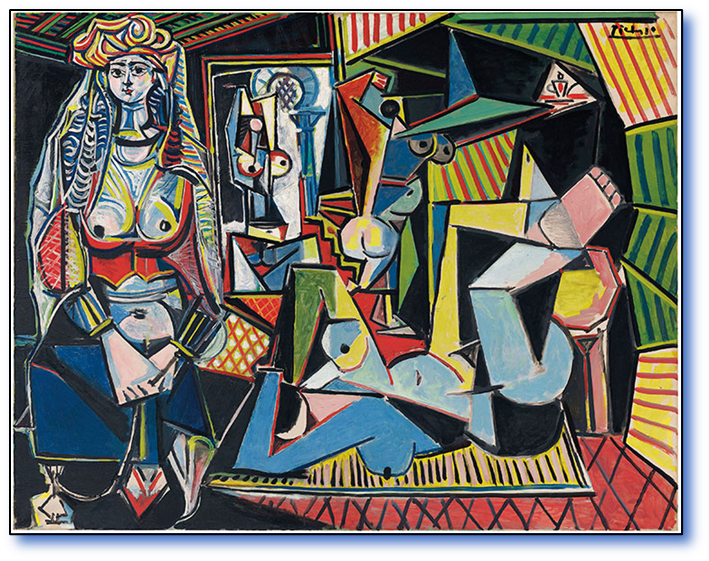
This is a portrait of a migraine.
The first version of this painting that I saw was such an exact visual description of a migraine attack that it should have been obvious to anyone who saw it what it was.
The border of the painting is a representation of the scintillating arc that typifies a classic migraine aura. Trust me, I’ve had enough of ‘em.
It starts a slight bright spot in the centre of the field of vision. It gets brighter, starts to glitter and then expands. It is very difficult to explain, but the border in the picture is a very toned-down snapshot of an aura. In reality, the whole thing pulsates and twinkles. “Twinkle” has to be understood as an approximation of what it looks like; there simply isn’t a word to describe it.
Now, if your lucky, you can have a “silent” migraine. One without pain. And then you can just sit and watch the show.
The stage that Pab has shown is towards the end of the attack. The aura is nearly fully expanded and beginning to fade out.
Now let’s look at the other elements in the picture.
You can see there are two distinct zones in the painting. On the left there is a reasonably realistic depiction of a lady. Really quite curvy, voluptuous and sexy. Don’t worry about her being blue, we’ll come to that later.
On the right-hand side, well. Body parts all over the place, we’re back to Frankie and the wolf.
This is also quite typical of a migraine.
One of the worst attacks I had, I was at work, talking to my boss, when I realised the left side of his face had completely disappeared. The right-hand side was perfectly normal, but the left side was as smooth and featureless as an eggshell. He didn’t usually look like this. Now, I should add, this was not a shock. It just seemed mildly interesting. Everything else in sight seemed to be OK, apart from the Northern Lights of the aura going on. Again, I will stress the complete normality of the situation.
This relates to the right-hand side of the picture being in such a state of chaos. Not to Pab. To him it would all just be what he was looking at. No more, no less. He might well see a face with two eyes on one side.
You’ll also notice that the background, where you can see it, is black. Morbid black.
That goes with the migraine as well.
There is no other way to describe it. Not “miserable” not “sad” not “suicidal”. Morbid
On the occasion I related, I was driving home in the winter twilight. A truck was coming up the hill towards me with its headlights on. There is an old music hall song about a man driving at night and seeing two lights coming towards him. “I’ll give those two cyclists a scare, I’ll drive between them. How was I to know it was a lorry? And now I’m playing the mouth organ in the sky”. This popped into my head and I thought “I’ll drive between those headlights” I wasn’t suicidal. I knew it would kill me. I was morbid. I remember the pain in my thumbs as I had to fight my own body to stop myself from driving between those headlights.
The point of this bit is the migraine really plays havoc with your thinking, perception and judgement. Seriously, do not operate heavy machinery, drive or even make a half-important decision after a migraine.
So, I can bet that Pab had migraines. I hope they were silent.
I think Pab started this series as his own version of a painting he admired by Delacroix. At some point, either during a silent migraine, or just after, he produced a “migrainised” version. And people liked it. They had never seen anything like it before. I think he went on with the series, frankly, tarting it up for its market value. Which involved a lot of messing about and a deal of toning down.
The final version, O, sold in 1997 for $31,902,500. I think the buyer bought the price tag, with a free picture to go with it.
I don’t know which version I saw that so grabbed me, but it ain’t O and I cannot find the others.
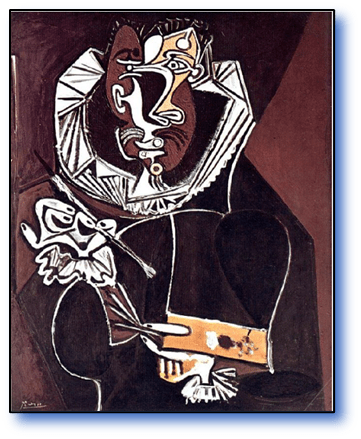
This is “Portrait of a Painter, after El Greco” 1950
This is the same migraine effect.
The morbid, dark background, the weirdly asymmetric and displaced features and the ruff, which is a very good monochromatic representation of an aura.
Tarting up and feedback
This process is part of the feedback I mentioned earlier.
Artists need to make a living. It matters not whether it is via patronage or sales or any other means. Make bread or starve.
Patrons wanted to see pictures that would look good on their walls. Some wanted to see themselves in the paintings. Some wanted to see their families bigged up or their rellies dragged up as emperors and stuff. Making grand theatrical gestures, as carefully posed and presented as a politician on the campaign trail. Which a lot of them were.
They also did not want to fork out good wedge for something so weird that all their mates would think them stupid for wasting their money.
It’s all marketing. And that has feedback limiting the type of work an artist can do.
I said if a 14th century Picasso were found it would freak you out. It would have freaked out and been dismissed by any contemporary art expert.
Steam Engine Time works in art as well.

 Flights of the butterfly
Leave a reply to Jem Cancel reply