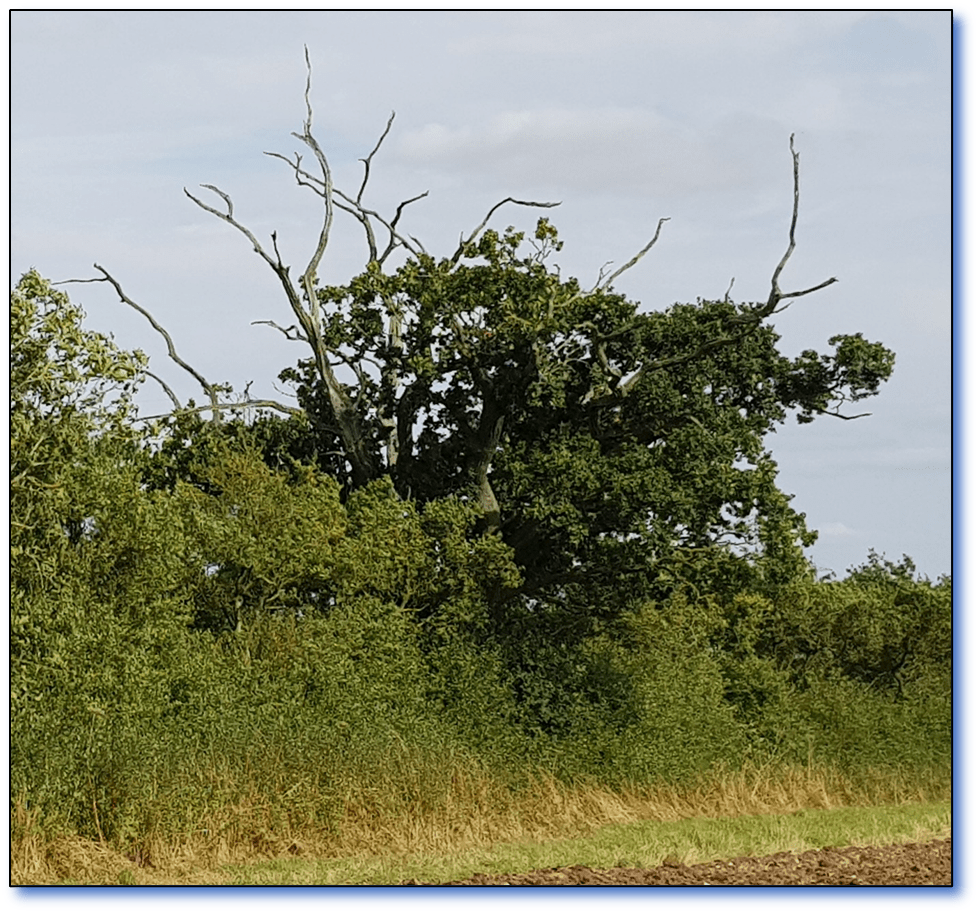
Once upon a time, there was a young oak tree. She lived in a hedgerow and hoped, one day, to grow tall and strong, like her friend in the next field.
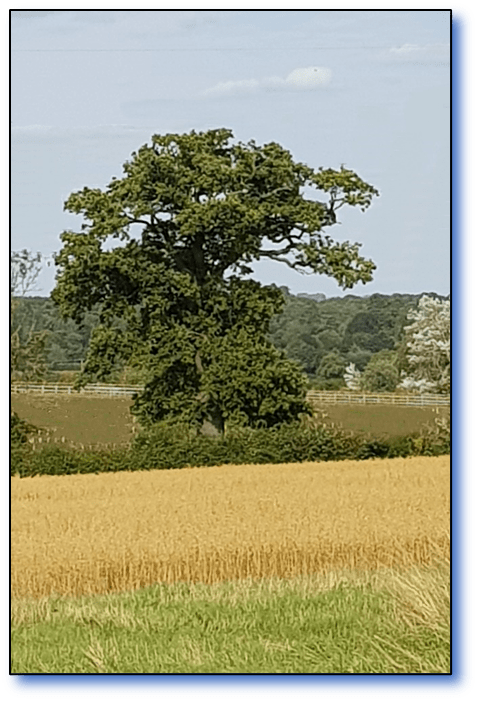
But, one day, she got sick.
Maybe it was tree flu, I don’t know. But she was very ill. And she “died”.
Only, of course, she didn’t. She was an oak tree, strong and brave.
So, she shut down and waited until she got better. She stopped making leaves, possibly because that was where the infection was coming from. But, without leaves, she was getting no sugar, so she couldn’t support all of herself. She shut down the limbs, the branches, to conserve her resources. She stopped sending sap up to all the branches, so gradually the wood changed, became hard and seasoned. It did not rot, the wood was full of tannin. It just stopped growing.
But, she did not starve, even without foliage. She was in a hedgerow with other trees and bushes. The fungi in the soil that connects the roots of all the vegetation brought her food from the other trees and bushes. The fungi brought sugar from the trees and minerals from the soil and gave it to the roots of the oak tree so that she did not die. The hedgerow kept feeding her, just enough to keep her core alive while she endured and fought the disease.
After a little while, a few decades, or even a century or so, she recovered. She started to push out new buds, leaves and twigs. She could not use the limbs that had completely hardened and seasoned. But the ones that still had some sapwood, she started to build from them. It took a while. Not long, just a few more decades, and then she was back. She started to pay back the other trees in the hedge, sending sugar and other chemicals through her roots and the fungus network to anyone in the hedge who needed it.
Now she stands again, proud, sturdy and strong.
A stag head oak. A testimony to strength and endurance.
This is not a fairy story. This happens. Parish records were used among other things to record details of land ownership. Frequently, boundaries were listed as including distinctive landmarks. A field would be listed as stretching up to “the large oak tree”
Then, decades later, the same field, same position, same size, was listed with the marker “the dead oak tree”
Again. Later, decades or even a century later, the same field is listed. This time it stretches to “the stag head oak.
That’s how we know this happens.
And we think we’re the clever, caring ones on the planet? Jog on.
 Flights of the butterfly
Leave a comment