Recently there has been a bad outbreak of waterborne disease in South West England.
As usual, the water company is wringing its hands and bleeding all over the carpet in anguish.
It turns out it wasn’t their fault at all. An “air valve” failed to open and so the water was not dosed with the appropriate additives. You can hardly blame the poor company. After all, if you install an air valve, a mechanical valve with a complicated air actuator, the associated solenoid valves and position switches, then you should be able to expect it to last at least a hundred years without failure. And anyway, what can a poor little company with no cash do about it anyway?
Well, Dummies, anywhere you install a valve that controls a medium that can affect the health and even risk the lives of people (you know –“peeple” – the cheap squishy things that pay your dividends), you install two valves so that it one fails, the other almost certainly won’t.
There are two main types of these valves: those that are normally open but must shut for safety, and those that are normally closed but must open at the critical time.
MORMALLY OPEN VALVE – DOUBLE BLOCK AND BLEED
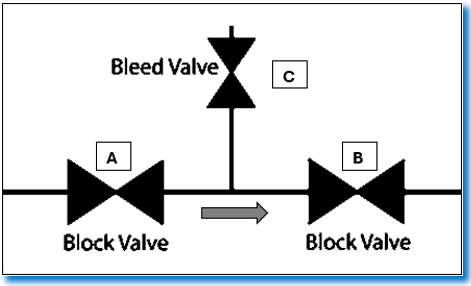
in This installation, there are two main valves that are normally open. The bleed valve, connected to the space between them can be used to monitor the line pressure – it should be the normal pressure for the flow range of the process. If it is required to close the valve, the upstream valve, A, should be closed. Then the bleed valve, C, line should show zero pressure, confirming tight shut off. If this signal is not correct, then the second valve, B, is closed, when the bleed valve line should signal full line pressure, confirming that the line is shut. In a lot of applications, it is acceptable to close Valve B first. If there is a failure, then B can be replaced while Valve A is shut. But, where it is vital that the valve shuts, using B as the back-up gives a clear signal at C that full line pressure is being held – it does mean a major shutdown to replace A, it depends on the criticality of the process.
NORMALLY CLOSED VALVE – MANIFOLD
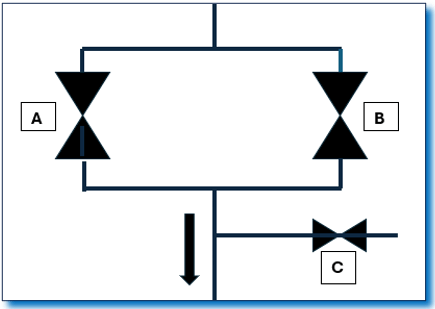
In this installation, either valve A or B can be opened to allow the medium to flow. In the case of failure to measure a process pressure at C, the other valve can be opened. Again, there are problems. If either A or B starts to leak and the medium can be a danger, there needs to be a further valve in the system to isolate it while emergency repairs are effected. With two valves, A and B, there is double the risk of a leak and that needs to be managed.
Now, for the Pipers among you, this has been simplified – no flow switches – no manual isolators and so on. But this is for those with a qualification in Meeja Studies and the like. And anyway, I’m a Gasser, so what would I know?
 Flights of the butterfly
Leave a comment