The universe is like an onion.
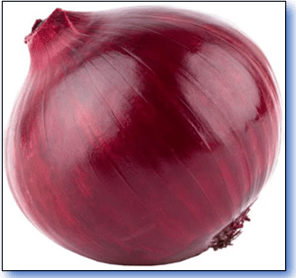
Well, not exactly, but there are aspects of it that are definitely onionesque.
I am referring to the solving of problems.
From this point of view there is a property of the universe that seems like an onion.
Trying to solve the mysteries of the universe, from our first perceptions as a baby and on to adulthood.
There is a stage after that and I will cover that later.
Quadratic equations are nice example. For some, there is very little “nice” about the things, but bear with me on this.

Quadratic equations are of the form:
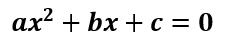
Sometimes you have to fiddle around with bits to make it look like that, following the rules of algebra, but sooner or later, you end up with something like it.
A bit more fiddling to get x isolated on the left-hand side and you get:
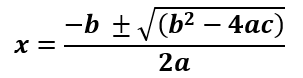
Now, once you’ve got the hang of that piece of nastiness, you can solve all quadratic equations. All of them.
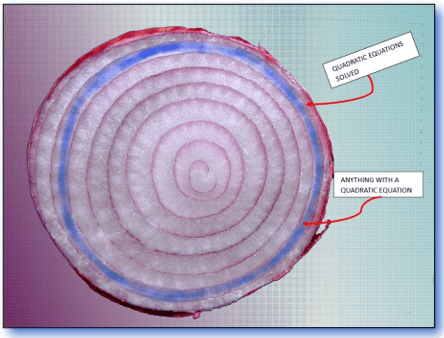
That means you can now tackle all the problems in the world that depend on that damn equation. So once you’ve pierced the “quadratic frontier” the blue zone is your oyster.
Until you come to the next tricky bit. The next layer.
If that doesn’t work for you, think about a toddler learning to walk. Once that skill is mastered, then the whole world opens up. Toddler can become independent, get everywhere faster than before.
And there’s more.
Now that toddler is upright, hands are free. Free to carry favourite teddy, grab precious vases from nearby tables, dial random numbers on your mobile. There’s a whole layer of the universe waiting to be conquered.
And now BALANCE has been learned. Now skateboards, bicycles, scooters are usable. And not just that. Balance means games like football, one of the simplest games, are available to be conquered.
As each layer is conquered, clues are found that will show a way to cross the frontier to the next layer.
Think about reading and writing. We think of these two things as going together. But they are completely different skill sets.
Reading. Easy. All you need is eyesight. Now, that in itself is no mean accomplishment. As I have said elsewhere, learning how to see, to understand what is being looked at and how to control where you look is a real skill. Just because most of us learn it very early does not make it trivial.
Once you have eyesight, you can recognise shapes.
This is a picture of a cat.
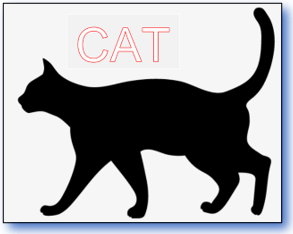
In addition to the silhouette of a cat, there are some meaningless squiggles. All you have to do is realise that the squiggles tell you that you are looking at a CAT. That is the basics of reading. Okay, I skipped a lot or really hard work, but the point is reading is a hands-free visual interpretation skill.
Writing? This is a needle and thread:
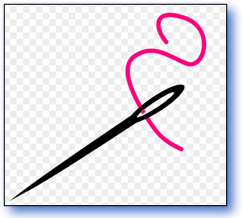
One of the simplest tools, been around thousands of years. Try threading a needle. Fiddly, innit? You need “fine motor skills” for that task. The same skills need to be mastered to do writing.
Now, you can’t master writing until you’ve got the hang of reading.
So you Read the “C” of the “cat squiggle” and you copy it with the writing skill. Then you learn how to recognise individual squiggles. They are letters.
And recognise sets of squiggles. They are words.
Then compare the results with the pictures. And with what you see. And with what you hear being said. And with the squiggles you have learned to draw.
When you’ve got the hang of that, you can read and write.
So, that was hard.
But even before that, you had to learn a language. You learned that from listening to the noises people make and working out how they matched up with what you were looking at, touching, tasting, and smelling. Not easy
And. You had to learn how to learn a language. This is a step that has often been overlooked, but is probably one of the most important developments we ever make.
There is a frontier all of its own. Learning how to learn a language.
Many years ago, a little girl had to have about 40% of her brain removed because of a tumour. This would involve removing what was considered the “language centre” of her brain and it was feared she would be left without communications, a helpless vegetable. But, to everyone’s amazement, she gradually learned again how to speak. She had not lost the ability to learn how to learn a language and her brain had simply rewired the available cerebral hardware to produce a new network that served as the language centre. I do not recall where I read this so you may wish to regard it as unsupported assertion.
Our world consists of loads of problems that need to be solved to allow us to live.
It seems that problems can be considered as layers. Once you have found a way into a layer of problems, then you can solve all problems that belong to that type. When we come across a new type of problem, we have to look around for a solution, then we can take on all the problems that belong to that type.
We discover how to make and control fire and suddenly, literally, great zones of the planet, otherwise not survivable, are opened up to us.
At the moment, we seem to be using logic as the best way to solve all problems. We have been doing this, we think, for thousands of years. It is so obvious to us, it seems to be the only way. Because we have been brought up to consider it as the only way.
If a problem is solved without a supporting structure, it is discounted as a lucky guess.
The only currently acceptable way to validated a proposed solution to a problem is to find a logic path that leads to the “guessed” outcome. Then turn the process on its head and publish the logic path leading to the outcome.
But it seems increasingly obvious that logic won’t take us across the next frontier.
Evolution has a way of doing this next step. Simply try anything and everything until something works.
We understand that life began in the oceans and then migrated to the dry land. That was quite a frontier. It seems likely that the process of evolution tried countless variations on the organisms existing at that time until some appeared that could move on to the dry land. And not die. This is quite a good method. Providing you are not one of those that perished.
This evolutionary type of exploration is available to the world of computers as demonstrated by Dr Adrian Thompson around 1996. Using “Field programmable gate arrays” he “evolved” a device that could tell the difference in frequency between two tones.
It took about 4000 generations of electronic crossbreeding for the system to produce a usable device.
It would seem that such a computer-based process must be running on logic. But there are two aspects at least that call that into question.
- The unit he used had 100 components. Logical thinking indicates that comparing frequencies will require some sort of clock. There didn’t seem to be enough components to build a clock, let alone do anything with it.
- When the final device was reviewed and analysed, it was found that not only was there no identifiable clock unit, there were components that were doing nothing at all. If components were removed one by one, it was found that only 37 were doing anything useful, but a further 5, doing nothing, could not be removed without ruining the thing. It is possible that these 5 had some effect via magnetic interference or some other effect. But you would be a very long time indeed finding such an interaction logically.
I believe that none of these “frontier crossings” have been purely the result of a logic-based process. The logic paths lead to the frontier, but locating the crossing is a different process.
I think the frontier crossing is one of three methods:
Evolution. The “Try anything once, twice if you like it” approach to finding a way through. Expensive both in time and resources.
Lucky guess. A random chance alighting on a gateway through the frontier. Such a purely random resolution should be very rare, but must not be discounted.
Inspiration. This looks like a lucky guess at first glance, but I feel it happens too often to be chance.
I am rather good at anagrams. Sometimes a word of up to twelve letters appears to just jump out at me. This happens far too often to be chance and far too quickly to be a logical analysis of all possible combinations of letters. There are about 6,000 twelve letter words in the English dictionary. I am not going to do a mathematical analysis of this lot. But it seems from experience that I recognise, possibly subliminally, letter groups and sequences and begin to link them up in what I call a Network Thinking process. This still seems to go far too fast for me to follow each pathway logically.
Thunderstorms. 13 letters. Now there’s a good idea.
A thunder cloud is wondering around, building up an enormous electric charge. The ground below is becoming heavily oppositely charged.
According to the United States Government (and if you can’t trust them, who can you trust?):
“Most lightning flashes are a result of negatively charged leaders, called stepped leaders. These leaders develop downward in quick steps. Each step is typically about 50 meters (150 ft) in length. Stepped leaders tend to branch out as they seek a connection with the positive charge on the ground. When a branch of the stepped leader reaches within about 50 meters of the ground or some object on the ground, it connects with an upward-developing positive charge, often referred to as an upward streamer.
Upward streamers tend to develop from the taller objects beneath one or more branches of the stepped leader. When the downward-developing negative stepped leader makes contact with an upward-developing positive streamer, referred to as the attachment process, a conductive path is established for the rapid discharge of electricity that we see as a bright flash.”
That seems to come close to what I experience as my Network Thinking. It explores so many possibilities that, logically, the overlap in the exploration process should make it way too slow for what I experience.
I think that part of my intelligence is coming to the fore at last. I feel that throughout my childhood and education I was channelled and coerced into the logic thinking straitjacket. I was put through the washing machine of mathematics, physics, chemistry until the network creativity had been cleansed.
Fortunately, like a lot of terrible diseases, it seems to have grown back.
Those that came out still stained with the creative juices were cast aside, condemned to “modern studies” or Art or even, god help us, Music.
This is a process of several thousand years of developing a schism between the disciplined logic thinkers and the wild and woolly Creatives, who probably grow beards and odd things like that.
The Creatives, the artists, musicians, poets and writers were the misfits and were left to find their own way. Mind you, the whole thing about this creative lark is that it’s not much use trying to guide and channel it. It wants to go its own way.
Creatives have this thunderstorm mind. They wonder around with a growing urge to make, do, write something. A storm cloud of creative pressure. They put out streamers of potential, looking for the high ground, the church steeple of the cultural landscape. When they find it, flash, bang. A book, a painting, a poem, although I can’t stand poetry, a play.
And there’s another bunch who have this ridiculous mindset. You may have met some of them, they’re called “Wimmin” or something like that.
Maybe it’s because they didn’t get put in the educational washing machine, maybe it goes with their other bits and pieces. They got told to stay at home because their faint little minds couldn’t cope with the big boys’ stuff of work and business. So they stayed at home, and just ran the house, brought up the kids, fed everyone, clothed everyone, got them to schools, stopped fights, nursed them when they were sick, argued with the neighbours, managed the budget, did the shopping, found the bargains. They deployed more management skills, project skills and who knows what else in the average day than their men did in a lifetime. They did it because the network mind can look at that lot and organise a path through it before the breakfast dishes have gone cold.
The point of this drivel is that the way through the next frontier is nearly always the inspiration from the network mind.
Just look at who made the big breakthroughs: Newton, DaVinci, Einstein, Picasso, Shakespeare. OK, I’m just picking a few and those are from European culture. They’re all out there. And they’re all weirdos who don’t quite fit into one category or the other. They all had the logical discipline to follow through on the wild path the network showed them. Think that doesn’t apply to Picasso? Take a good look at his work, there is as much discipline in his art as the most boring dissertation on geology you ever heard. Geologist, take a bow, there have been some true inspirations amongst you. Tectonic plates? Who knew? What a weird idea that was.
If we want to push through the frontiers into the next juicy bit of the onion, we need all of these and more.
We have to find a way to encourage network creativity in the scientific and technological disciplines.
This has taken 5 pages and I am sorry. If there is anyone left out there, just going for coffee and a smoke, then I’ll finish up.
Promise.
OK.
The problem we face is that getting those network minds engaged in the next frontier is a bit like herding cats. Network minds are creative and they don’t do discipline until the lightning flash shows them where to go. Then you can’t stop ‘em with a truck.
We need to find out how to present the frontier and the logic paths leading up to it in a different way. At the moment, all we can do is wait for a mind both logic disciplined and network wired to follow the logic paths and either find a new path or go back and follow a side path that had been discounted. These paths are now too long and complex for an independent network mind to join at a later point and follow from there. We have to find a way of letting the creative network mind join the search without starting from first principles.
A creative mind would know how to do this, but I’m stuck.
 Flights of the butterfly
Leave a comment