I wasn’t expecting to be doing this so soon. It’s beginning to sound like I’m banging on about stuff.
But, I bumped into an article in the Times about our old mate Frankie.
Time marches on and things change:
1877 Merson Luc Olivier
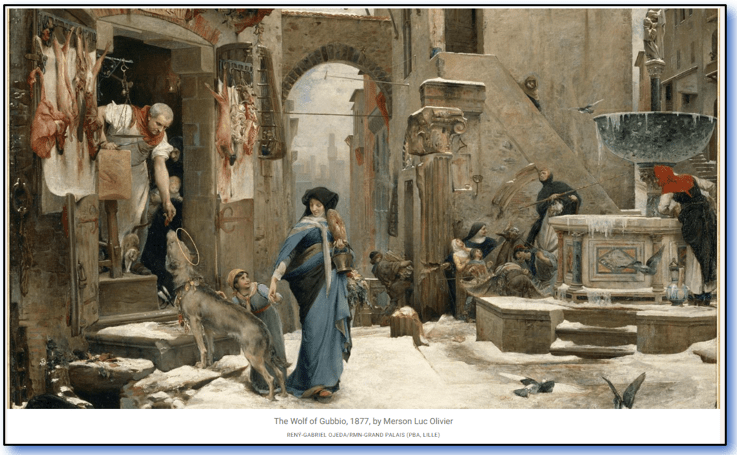
This is very clearly a completely different kind of art. A lot has moved on since Stevie had a go in about 1440.
From our viewpoint, the technical details are far more aligned with how we see the world.
There have been three world shaking inventions that took art and humanity forward:
- Photography
- Paper
- Pencil
Photography
Louis-Jacques-Mandé Daguerre (1787–1851), a Romantic painter, first showed what we recognise as a photo to the French Académie des Sciences on January 7, 1839.
The world changed and the rest is history. This is the beginning of the era of recording sights directly without the filter of the artist’s brush. Sure, the photographer’s selection of shot and subject add an interpretation, but it is now possible to examine a scene “forensically” and see what is actually there, separated from an impression of what we saw.
Paper
OK, paper is tricky stuff. Been around since the ancient Chinese, blah blah blah.
But, 1799, patent granted to a Froggy – Nicholas Louis Robert – for a continuous paper making machine.
Now we’re up and running. Paper becomes readily available. Artists can grab a sheet and start sketching, right there and then. Maybe only an outline. Maybe something about a cloud, a cat, a woman’s hand. Something that helps with his next big work.
But what he really needs is the other thing
Pencil
The modern pencil was invented in 1795 by Nicholas-Jacques Conte, a scientist serving in the army of Napoleon Bonaparte.
And, Bang! We’re modern.
To me, Pencil, Paper and the Ruler are the three greatest inventions of the past two thousand years. Look around you, think about it. If you disagree, make a quick note.
In pencil,
On paper
On a line drawn with a ruler.
With this tripod of inventors’ triumph, human development is off to the races. And so is art.
Art becomes truly portable.
Messy Luke could pop down to the butchers and spend all day sketching the rabbits to see exactly how they looked, how they hung. He could even shade it so that he could get the colours right later on. He could sit and stare at icicles until his feet froze. Maybe he could even get a photo and study it in the warm. He could sit and watch pigeons, cats and dogs and keep sketching until he got what he was looking at.
But: Messy Luke’s wolf is still a dog. A good one. But we, who have seen photos of wolves, know it ain’t no wolf.
Also, photography is still in its infancy. Requires long exposures. Good for landscapes. Not good for people. Still need carefully posed compositions. The lady and the little girl still look stilted with artificial posture and gesture.
And it will be a long time before someone gets a shot of a wolf.
Snuff of this. I need coffee.
Frankie and the Greek (1590-95)
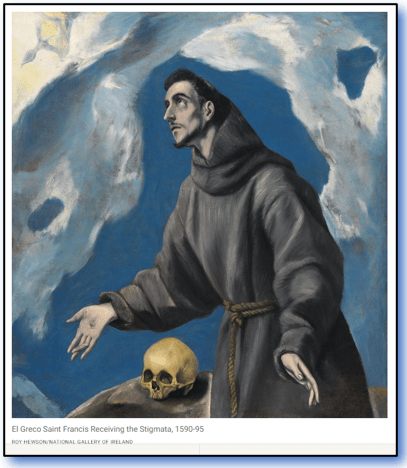
This isn’t about the wolf. But, just look at the anatomical accuracy of the skull. This took time and study to get it right. Also notice that this is an aged skull. It’s been around as a skull for a long time. Time enough for the bone to have begun to turn yellowy brown. The cloak is well done, if it is heavy wool. Sleeves probably not hanging quite right yet, but getting close to what we recognise having seen them in photos.
But: the face. The face is very modern. You know this man, you’ve seen him in a shop or on a train somewhere.
Go back to the faces in Stevie’s effort, around 1440. Not much in the way of real, recognisable faces.
Look at St Seb (1475). Things have really changed. All the “extras” have real faces, but the star, Seb, still looks completely unreal. An absolute prawn.
A hundred years and El Greco has got a live one.
Which is why he is seen as way ahead of his time. But, weird hands. Very posed, very stylised. But, this is about “receiving the stigmata” supposedly the wounds that Christ received at the crucifixion.
(side note: the wounds are in the wrong place. Putting nails through the palm would not take the weight of a human body, they would tear out between the fingers. For crucifixion, nails would be put through the wrist, between the bones of the forearm. Or else, just use rope to tie the prisoner to the cross. Spoiled your breakfast.)
What really strikes me about this painting is the sky. This is so far from what we recognise that it is really saying “This isn’t your reality. This is something else, somewhere where all the rules we know don’t apply. This is a miracle”
Frankie by Frank (1904)
And now we’re really modern.
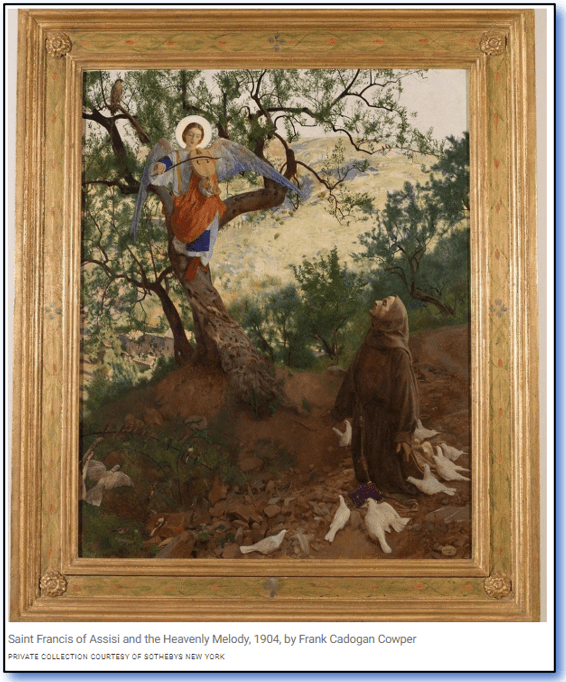
This is “real” by our standards. In a photographic world, you can see how trees and pigeons look and keep trying until you get it right. The angel in the tree ( not a phrase I use often) has been given a soppy face deliberately, to show it is an angel and not some tart busking where you won’t get a penny.
And this poses a problem for artists from here on. They have to compete with photography. They have to do something different to make their work different from a photo.
Frankie by Stan (1935)
And so you get this.
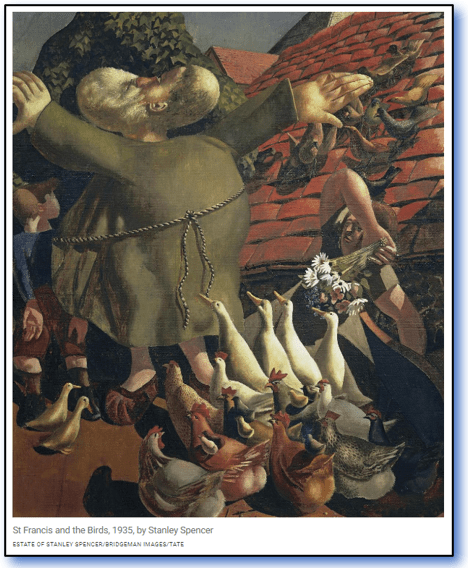
I think Stan is trying to put something more than a photo in here.
Doesn’t seem worth the effort. I think it belongs to the “if you don’t get this, then you just don’t understand” school.
I neither get nor understand it.
And I feel good about that.
 Flights of the butterfly
Leave a comment